Get Your Free In-Home Personalization
- Home
- Avimor, ID
Avimor, ID

When an entire home needs window coverings, starting with a product catalog can make the project more complicated.
Start with the rooms instead.
Which bedrooms need stronger privacy or room darkening? Which living spaces receive direct sun? Does a home office have glare across a monitor? Are any windows difficult to reach? Do bathrooms need a material that is easier to maintain around moisture? Which prominent openings should contribute more strongly to the architecture?
Those answers create a practical window plan.
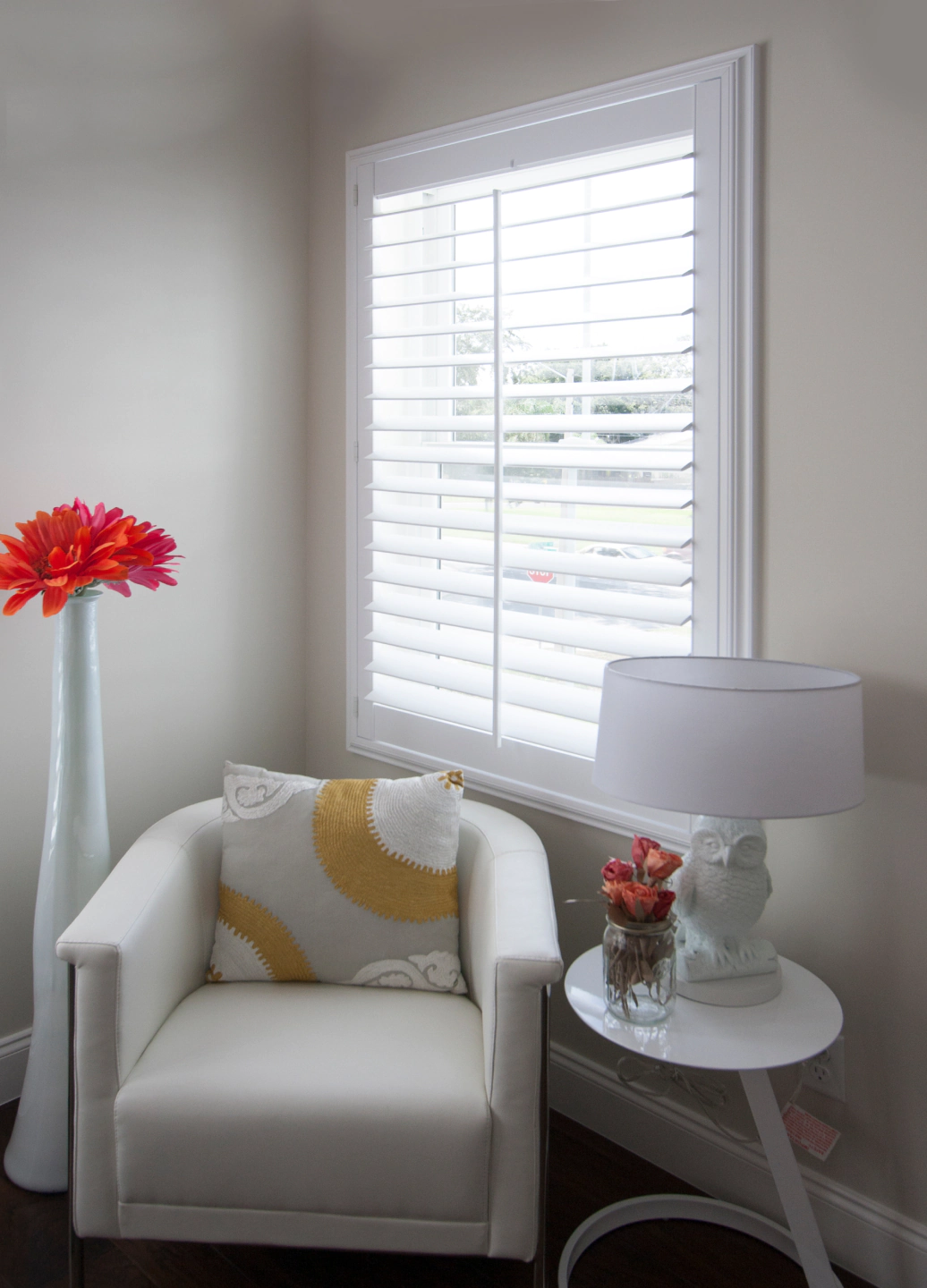
A great room may benefit from custom plantation shutters that become part of the architecture and allow daylight to be adjusted through movable louvers. Another large window may be better suited to a streamlined roller shade that keeps the glass visually open.
Bedrooms might call for cellular or room-darkening shades. Faux wood blinds can make sense where adjustable slats and straightforward upkeep are priorities.
Once the functional choices are clear, we can coordinate colors, finishes, fabrics, and materials so the rooms still feel connected.
This prevents a common new-home mistake: selecting the same treatment everywhere for visual consistency and later discovering that several rooms need different levels of privacy, insulation, glare control, or operation.
Consistency can come from the design language. Function should come from the room.
Motorization is easier to consider when it is part of the window plan rather than an afterthought.
In a new home, you may already be thinking about lighting, thermostats, security, entertainment, and other connected features. Compatible motorized window treatments can become another part of that conversation.
Depending on the selected product and control system, motorized shades may support remote, application, voice, or other compatible smart-control options.
The strongest reason to use motorization is convenience where convenience matters.
A high window can be difficult to reach. A large bank of shades may be tedious to adjust individually. A sun-exposed room may benefit from treatments that are easy to reposition as conditions change throughout the day.
Other windows may not need automation at all.
A manually operated treatment at normal height can be simple and practical. Cordless operation may provide the clean control style you want without adding a motor. We help distinguish where smart operation adds value from where it simply adds another feature.
Planning early also allows compatible treatments across multiple rooms to be considered together.
We can discuss which windows you expect to operate frequently, which are hard to reach, and how you want to interact with them. From there, we narrow the products and control options to systems that fit the actual home.
A whole-home project benefits from a focused group of products that can solve different problems while still coordinating visually.
These options can be combined throughout a new home.
The purpose is not to introduce unnecessary variety. It is to give each room the function it needs while using finishes, colors, and proportions to create continuity.
New windows can look similar on a floor plan while behaving very differently after you live in the home.
Direction matters.
One room may stay comfortable for much of the day while another receives strong sunlight across furniture, flooring, television screens, or work surfaces. Large expanses of glass can also change how much solar exposure a room experiences.
That is why we evaluate sunlight at the property.
For direct glare, a roller or solar shade may be useful because fabric can be selected according to the amount of light you want to filter and how much outward visibility you want to retain.
For a room where insulation at the glass matters, cellular shades provide honeycomb-shaped air pockets that create an additional thermal layer.
Plantation shutters approach sunlight differently. Adjustable louvers allow light to be redirected while the shutter remains part of the window.
Faux wood blinds also provide adjustable slats and can be practical where easy maintenance is a priority.
These distinctions are easier to understand with the window in front of us.
During the in-home personalization, show us which rooms receive the strongest sun and when the exposure becomes noticeable. We can compare materials in those conditions rather than assuming every side of the house needs the same opacity or construction.
Daily operation matters as much as appearance.
A treatment can be beautifully coordinated with a new home and still become frustrating if it is inconvenient to adjust.
For family spaces, cordless window treatments may provide a cleaner operating approach by eliminating dangling cords. Available cordless configurations vary by product, size, and system, so we consider operation alongside the treatment itself.
Motorization can provide another option where compatible.
Tall windows, windows behind furniture, large treatments, or multiple shades that need frequent adjustment can be easier to manage with powered controls.
The important part is to think about how the room will actually work after move-in.
Will someone adjust the treatment every morning and evening? Will furniture eventually block access to the window? Is the treatment in a child’s room? Will several shades need to move together? Is the window high enough that manual operation will become inconvenient?
These questions can change which control style makes sense.
We discuss them before products are ordered, not after installation.
That allows the treatment, control system, and window dimensions to be planned together.
Some new-home windows benefit from a treatment that feels more permanent.
Custom plantation shutters are built around the opening and can create that effect. Instead of appearing as a separate layer hanging in front of the window, the shutter frame becomes closely related to the surrounding casing and architecture.
That makes the details important.
Louver size changes both the view through the shutter and its proportions. Frame style affects how the treatment meets the existing trim. Panel layouts and breakpoints need to make sense for the shape and dimensions of the opening.
The owner personally handles these measurements and layouts.
We can also compare wood and composite construction according to appearance, maintenance, room conditions, and the finish you want.
For new homes with strong sunlight, composite or faux wood materials may also be worth considering where their material characteristics fit the room better than natural wood.
Samples allow us to compare finishes with the home’s trim, flooring, cabinetry, doors, and other installed materials.
Plantation shutters include a lifetime warranty, which also makes them worth considering for prominent openings where you want a long-term architectural treatment rather than something selected only for immediate coverage.
A coordinated window plan should feel intentional when you walk through the house.
That does not require every window to look identical.
Suppose the main living area uses plantation shutters. Bedrooms could use cellular shades in a related neutral tone. A bathroom might use faux wood blinds that coordinate with the trim. A home office could use a roller shade selected for glare control.
The products are different, but the home can still feel connected.
Color is one way to create that relationship. Material undertones, hardware, visual weight, and the way treatments meet the trim can also help.
Our in-home sample process is especially useful on whole-home projects because we can move materials from room to room.
A fabric that works beside the living room flooring may look very different against bedroom paint. A faux wood finish can be compared directly with trim. A shutter sample can be evaluated beside cabinetry or doors.
We can also decide where contrast is appropriate.
Some windows should blend quietly into the architecture. Others may deserve more visual presence.
Planning those relationships together gives you more control than choosing products independently over several months and trying to make them coordinate afterward.
New construction does not eliminate the need for individual measurements.
Windows that appear identical can have small differences in width, height, depth, trim, squareness, or mounting conditions. Those differences matter when the product is being custom ordered.
We measure each relevant opening.
Depending on the treatment, the owner evaluates width, height, frame depth, trim, sill conditions, clearance, mounting surfaces, nearby hardware, and the space required for operation.
Plantation shutters can require additional layout decisions involving frames, louvers, panels, and breakpoints. Roller and cellular shades need appropriate mounting depth and clearances. Motorized treatments introduce their own hardware and operating considerations.
This work happens before the order.
Every product is then custom ordered specifically for the windows it will cover.
Saddleback Shutters & Blinds does not subcontract this process. The owner personally handles measurements and opening layouts, keeping the technical details connected to the design conversation that happened during the consultation.
Our family also handles installation.
Treatments are mounted, aligned, tested, and adjusted according to the selected system. Compatible motorized products are tested with their controls so operation can be reviewed before the project is complete.
A whole-home project becomes easier when the decisions follow a clear sequence.
Use this checklist as a starting point:
This gives us a practical framework for the in-home consultation.
You do not need to decide the exact product for each room beforehand. The goal is simply to identify what the windows need to accomplish.
We can handle the product comparison from there.
New homes often contain a carefully selected palette of flooring, cabinetry, countertops, wall colors, hardware, and trim.
The window treatments become another part of that palette.
A finish that looks neutral on a sample card can reveal warm or cool undertones when placed next to cabinetry. A shade fabric may appear lighter when backlit. Faux wood can relate differently to painted trim than natural wood. Shutter colors can either blend into the casing or create intentional contrast.
We bring samples into the home so those differences can be evaluated directly.
This also helps when you are choosing products for several rooms.
We can compare materials under different lighting conditions and see whether a color that works in the great room still makes sense in a bedroom or office.
At the same time, we keep function in the conversation.
Appearance should not cause you to overlook privacy, glare, insulation, maintenance, or operation. Likewise, solving a functional problem does not mean the treatment should feel disconnected from the home.
Our role is to help those decisions meet in the middle.
There is no high-pressure sales process. We explain the options, show you the differences, and recommend what fits the room rather than automatically steering you toward the most expensive product.
Not necessarily. Different rooms can require different privacy, light, insulation, maintenance, and operating characteristics. Treatments can still be coordinated through color, finish, proportion, and material choices without being identical.
Motorization can be useful for tall or hard-to-reach windows, wide treatments, multiple shades, or rooms where frequent adjustment is expected. We consider whether automation solves a practical problem before recommending it.
Compatible products may support app, remote, voice, or other smart-control options depending on the selected treatment and system. We review compatibility during product selection rather than assuming every motorized product works with every platform.
They can be useful where adjustable light control, privacy, moisture resistance, and straightforward maintenance are priorities. We compare them with wood blinds, shades, and shutters according to the specific room.
Yes. Small differences in dimensions, depth, trim, and mounting conditions can affect custom-fit products. We measure the relevant openings before placing the order rather than assuming repeated windows are exactly the same.
Mon – Fri: 8:00 AM – 7:00 PM
Sat – Sun: Closed
Tell us which Avimor, ID rooms still need window coverings. We’ll bring samples and help you coordinate privacy, sunlight, materials, and control options throughout your home.